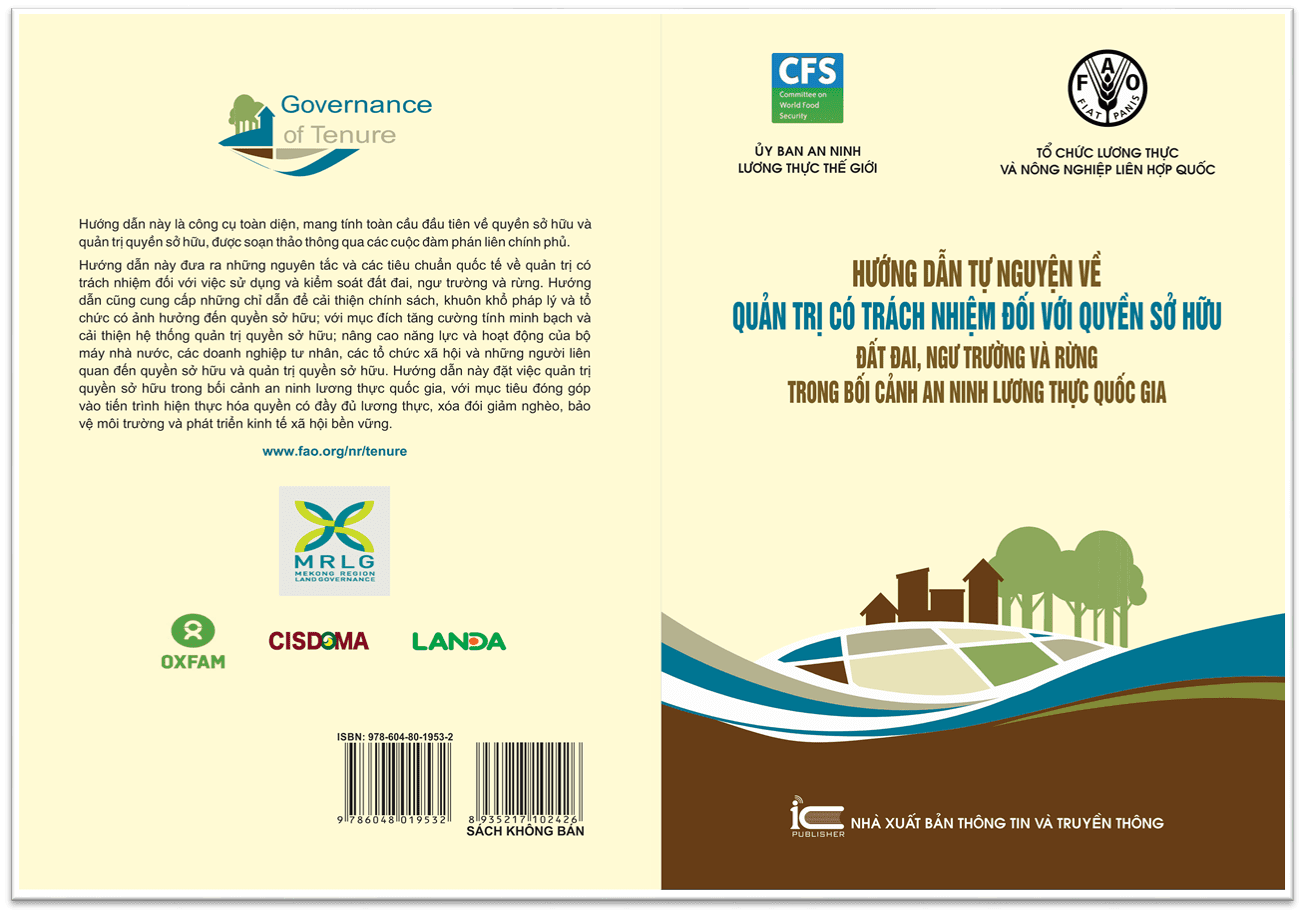
The “Voluntary Guidelines on the Responsible Governance of Tenure of Land, Fisheries and Forests in the Context of National Food Security” (VGGT) have been recently published in Vietnamese by: The Food and Agriculture Organization of the United Nations (FAO), Oxfam in Vietnam, The Consultative Institute for Socio-Economic Development of Rural and Mountainous Areas (CISDOMA), and the Land Alliance (LANDA), with support from the Mekong Region Land Governance (MRLG) Program. These Guidelines are the first comprehensive, global instrument on tenure and the governance of tenure of land, drafted through intergovernmental negotiations.
The purpose of these Voluntary Guidelines is to serve as a reference and to provide guidance for improving the governance of tenure of land, fisheries, and forests, with the overall goal of achieving food security for all and supporting the progressive realization of the right to adequate food in the context of national food security.
These Guidelines set out principles and internationally accepted standards for responsible governance of the use and control of land, fisheries, and forests. The Guidelines also provide directions for improving policies, legal frameworks, and organizational structures that affect tenure; with the aim of enhancing transparency and improving tenure governance systems; and strengthening the capacity and operations of state administrations, private enterprises, social organizations, and those involved in tenure and tenure governance. These Guidelines place the governance of tenure in the context of national food security, with the objective of contributing to the progressive realization of the right to adequate food, poverty eradication, environmental protection, and sustainable socio-economic development.
This set of Guidelines can be used by the State; executive and judicial bodies; local authorities; organizations of farmers, small-scale producers, fishers, and forest users; livestock keepers; indigenous peoples and other communities; civil society organizations; the private sector; research institutions; and all those involved in assessing tenure governance, identifying improvement measures, and implementing them.
In Vietnam, land conversion is rapidly taking place and attracting the attention of the entire society and policymakers. The Government is updating and amending policies and sub-law documents to ensure effective implementation of the 2013 Land Law. In this context, the VGGT can serve as a good reference for relevant stakeholders, especially for Civil Society Organizations (CSOs) as they engage in land management processes in Vietnam, contributing to promoting more responsible land governance and securing the rights of marginalized groups.
The Vietnamese translation of the VGGT was implemented by organizations including Oxfam, CISDOMA, and LANDA with support from MRLG and consultation with land experts to ensure the Vietnamese translation is appropriate for the Vietnamese context.