
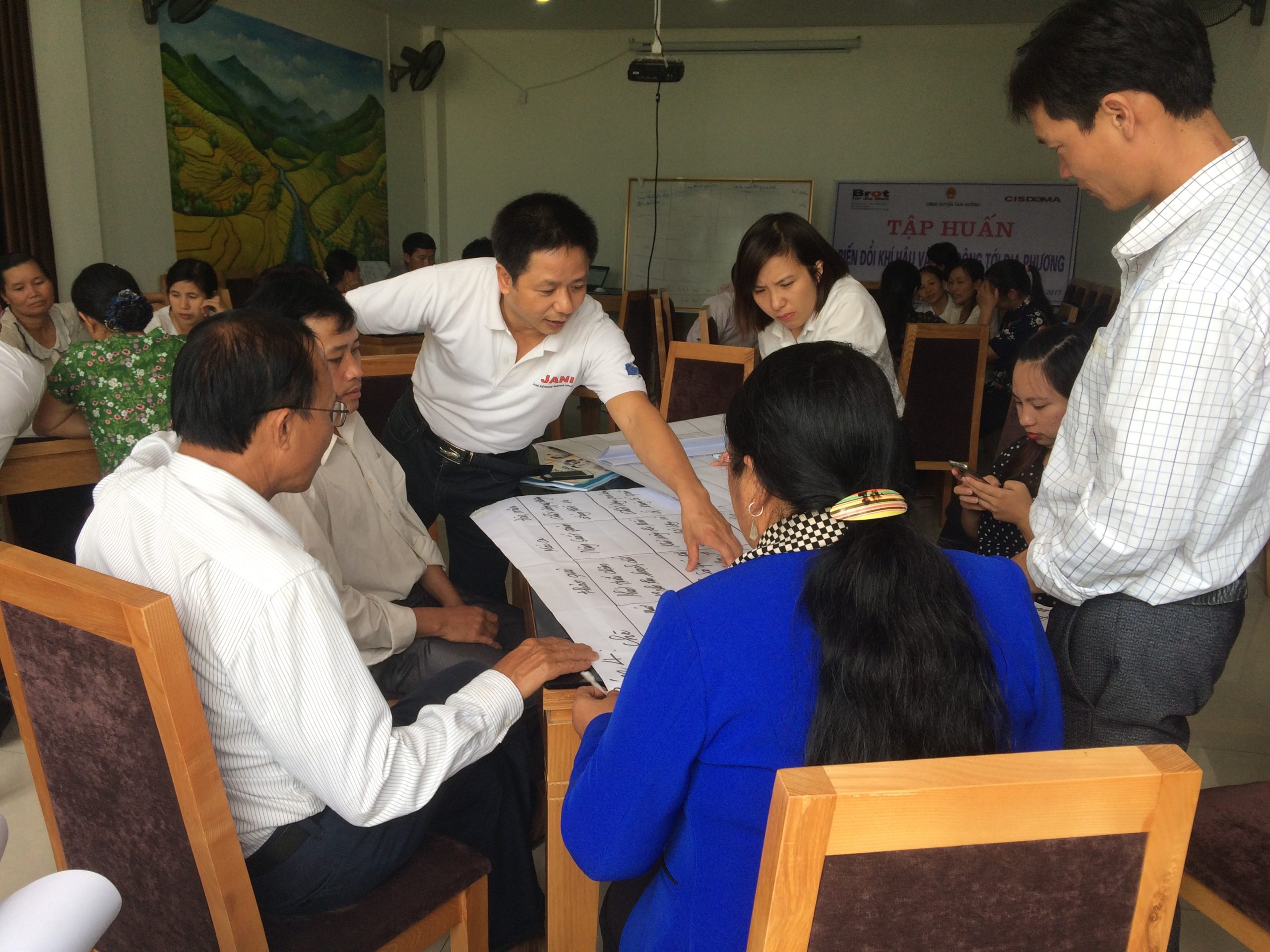
The document was compiled within the framework of the project “Strengthening Legal Knowledge and Legal Assistance to Ensure Equal Land Rights for Ethnic Minority Women.” The project was funded by the German Federal Ministry for Economic Cooperation and Development (BMZ) through Bread for the World and the INKOTA network. The Consultative Institute for Socio-Economic Development of Rural and Mountainous Areas (CISDOMA) coordinated with functional agencies to implement the Project in Mai Chau district, Hoa Binh province, and Que Phong district, Nghe An province, from 2020 to 2022.
Issues related to land use rights often have significant impacts on the lives of ethnic minority people in Vietnam because their livelihoods depend primarily on land and forest resources. To support the socio-economic development of ethnic minority people, the Party and State of Vietnam have been attentive in issuing specific policies and guidelines aimed at resolving issues related to residential land and production land for ethnic minority people, especially poor ethnic minority households living in difficult areas. However, ethnic minority people in general, and ethnic minority women in particular, still have limited access to legal information on land for developing family economies and ensuring equal rights in land management and use.
The project “Strengthening Legal Knowledge and Legal Assistance to Ensure Equal Land Rights for Ethnic Minority Women” was implemented in Mai Chau district, Hoa Binh province, and Que Phong district, Nghe An province, from January 2020 to October 2022. The project aimed to promote gender equality in land management and use through direct communication and legal consultation activities. In Mai Chau (Hoa Binh), CISDOMA coordinated with the Provincial Women’s Union of Hoa Binh, the Provincial Legal Aid Center of Hoa Binh, and the Mai Chau District People’s Committee when implementing project activities in 6 communes. In Que Phong (Nghe An), CISDOMA coordinated with the Provincial Legal Aid Center of Nghe An and the Que Phong District People’s Committee when implementing project activities in 13 communes and towns.
The document “Model for Communication and Legal Consultation on Land Law for Ethnic Minority Women” is the result of synthesizing and analyzing information from project documents, reports, and field trips in the project areas. Through this document, CISDOMA wishes to share the model with agencies and units responsible for legal communication and dissemination, as well as social organizations, so that the model can be replicated in many localities with similar contexts across the country, contributing to achieving the goal of gender equality in land management and use.