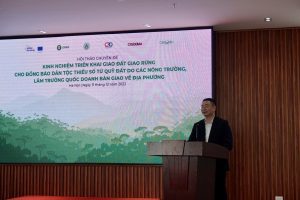
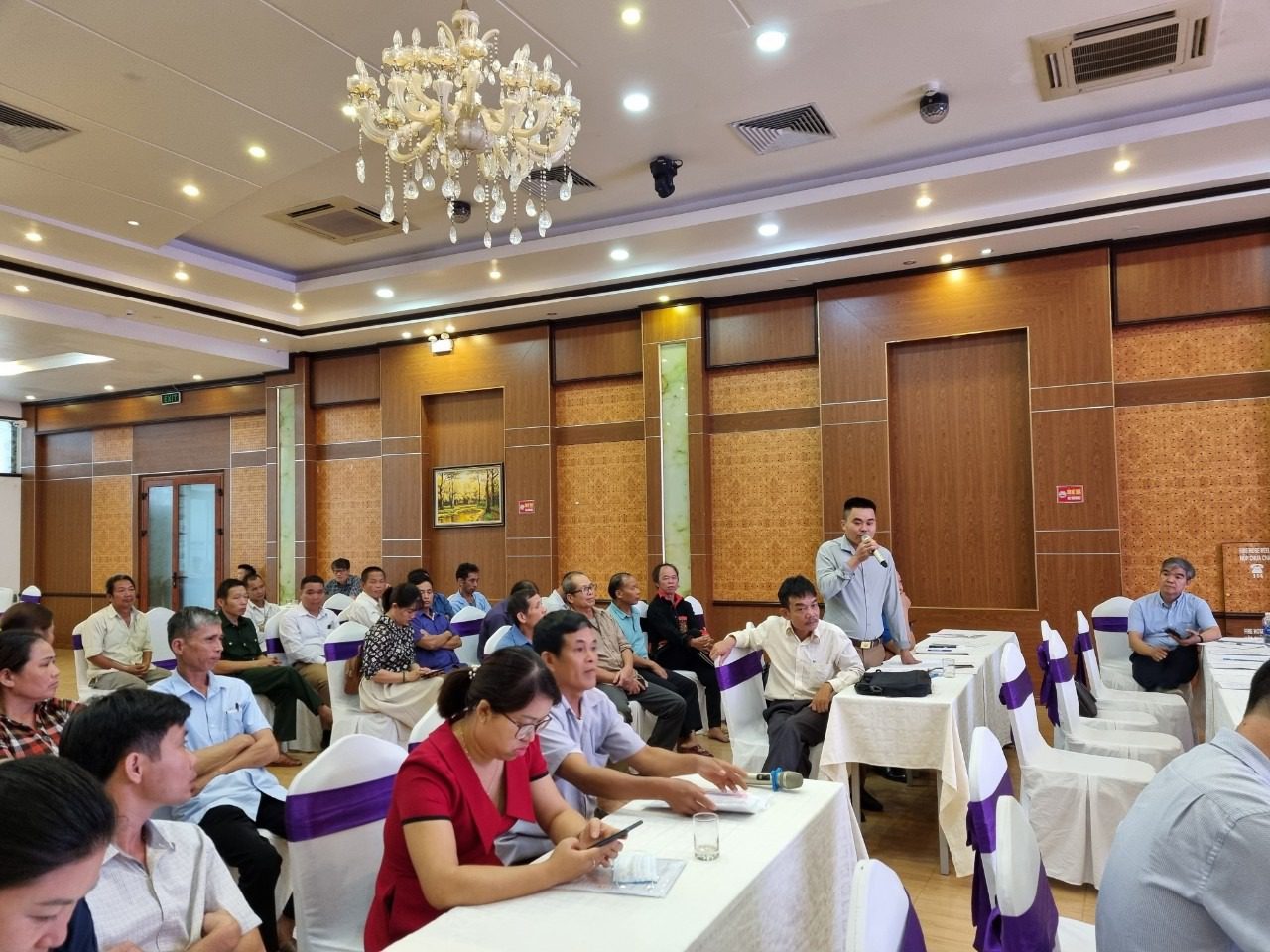
The launch workshop was co-organized by the Hoa Binh Provincial Department of Agriculture and Rural Development (DARD), CISDOMA, and ICRAF on August 5, 2022, at the Hoa Binh Provincial Convention Center. Nearly 80 delegates attended the workshop, representing provincial departments and agencies of Hoa Binh, including the Department of Planning and Investment (DPI), DARD, the Sub-Department of Crop Production and Plant Protection, the Hoa Binh Provincial Agricultural Extension Center, the Department of Agriculture and Rural Development of Kim Boi District, ICRAF, CISDOMA, local authorities, and participating farmers.
I. Project Overview and Discussions
At the workshop, delegates listened to presentations providing an overview of the activities and expected results of the Project. Project implementing units and delegates also discussed the Project’s new approach based on Agroecological Landscape and addressed some difficulties and challenges in agricultural production, product consumption, and issues that the Project aims to resolve.
The Project “Agroecology for Sustainable Landscape to Reduce Poverty for Ethnic Minorities in the Northern Mountains” is mainly funded by the German Federal Ministry for Economic Cooperation and Development (BMZ) through Bread for the World (BfdW). The Project is co-funded and implemented by the International Centre for Research in Agroforestry (ICRAF) and the Consultative Institute for Socio-Economic Development of Rural and Mountainous Areas (CISDOMA). The total Project budget is over 1.4 million EUR, implemented in Kim Boi district, Hoa Binh province, and Tram Tau district, Yen Bai province, over 4 years, from 2021 to 2025.
II. Key Contributions and Commitments
The workshop was attended by Mr. Vuong Dac Hung, Deputy Director of Hoa Binh Provincial DARD, who gave the keynote address.
- DARD’s Direction (Mr. Vuong Dac Hung): He emphasized that for the Project to succeed, it requires the involvement of specialized departments, local authorities, and the contribution and positive response of the people. DARD committed to strengthening its direction and monitoring of the Project’s implementation in the province, highly appreciating the coordination of CISDOMA, the Sub-Department of Crop Production and Plant Protection during the conceptualization and design phase, and the support from ICRAF and BfdW.
- DPI’s Perspective (Mr. Duong Van Trung): The representative of the Department of Planning and Investment raised the issue of local and community contribution to the Project to enhance the sense of ownership and responsibility among beneficiaries. He stressed the need to ensure the matching funds required by the donor. He concluded by highly praising the contributions of both international and Vietnamese NGOs to the economic, social development, and environmental stability of the locality, and committed that the Hoa Binh DPI would always create the best conditions for organizations to work and support the people in Hoa Binh.
- Local Leaders’ Concerns: Representatives of the participating communes raised several issues of concern to the residents: (1) Excessive use of chemicals in agricultural production affecting the environment and product quality; (2) Insufficient attention to planning agricultural production, which is often based on intuition and following trends; (3) Lack of guaranteed market for products. Therefore, the Project is expected to help solve environmental pollution, restore the agricultural ecosystem, and is considered a vital project for Kim Boi.
- Farmers’ Voice: The workshop included over 30 farmers representing households from Hop Tien and Tu Son communes. Farmer representatives shared difficulties in local agricultural production, such as water scarcity, heatwaves, whirlwinds during planting season, product market access, techniques, and seed sources. They committed to participating in the Project and expressed a desire for wider replication to involve more households.
The workshop concluded with a commitment from all parties to participate in the Project with the highest sense of responsibility to ensure timely progress, high efficiency, adherence to donor regulations, commitment agreements, and compliance with the law. Delegates expressed confidence that the Project would develop successful models contributing to stable income for farmers, improving local agricultural and forestry production toward sustainability, and creating a stable agroecological environment in harmony with nature.
🇻🇳 Giai đoạn 2 Dự án tại Tam Đường, Lai Châu (2022 – 2025)
From July 2019 to June 2022, with support from Bread for the World (BfdW) and Action on Poverty (AoP), CISDOMA successfully implemented the project “Strengthening the Resilience of Poor Households through Climate Change Adaptive Livelihoods” in 3 communes of Tam Duong district, Lai Chau. The supported livelihoods, such as beekeeping, raising local pigs, growing grass for fish farming, growing straw mushrooms, and community tourism, contributed to increasing production capacity and income for residents, as well as fostering community cohesion.
To maintain and scale up the project results, CISDOMA and the Tam Duong District People’s Committee developed a proposal and successfully advocated for BfdW and AoP to fund Phase 2 (July 2022 to June 2025), expanding the project to include 3 more communes. In Phase 2, CISDOMA will continue to coordinate with functional units in the district to promote agroecology solutions, community tourism, and Village Savings and Loan Associations (VSLAs).
The project’s approach to promoting agroecological practices follows a multi-step process (as illustrated in the provided diagram).
The approach to promoting community tourism is divided into 3 stages:
- Survey and Planning: Building a Community Tourism (CT) development plan for each village; designing detailed experiential tours; promoting the establishment of CT Management Boards and community tourism service groups in the villages.
- CT Development Support Activities in the Village: Training courses to enhance tourism service capacity; technical and financial support for families and communities to upgrade facilities and purchase equipment for tourism; guiding households in building investment plans for bank loans; developing CT development guidelines for the villages.
- Communication and Market Linkage Activities: Experiential tour programs connecting customers and the market; designing promotional communication videos and posters.
VSLA activities are implemented in coordination with local Women’s Union chapters according to the following steps:
- Selecting Women’s Union officials for training to become core facilitators.
- Core facilitators, together with the project, establish and maintain VSLA groups in the villages.
- Promoting the application of IT in VSLA group activities.
By implementing Phase 2, the project is expected to contribute to increasing the income and quality of life for ethnic minority households in the project areas through the application of agroecological solutions, community tourism, and Village Savings and Loan Associations.