From July 2019 to June 2022, with the support of Bread for the World (BfdW) and Action on Poverty (AoP), the Consultative Institute for Socio-Economic Development of Rural and Mountainous Areas (CISDOMA) successfully coordinated with the Tam Duong District People’s Committee (Lai Chau) to implement the project “Strengthening the Resilience of Poor Households through Climate Change Adaptive Livelihoods” in 3 communes in Tam Duong district. The livelihoods supported by the project, such as beekeeping, raising indigenous pigs, growing grass for fish farming, growing straw mushrooms, and community tourism, contributed to enhancing production organization capacity and income for the local people, as well as fostering community cohesion in the project area.
To sustain and replicate the project’s results, CISDOMA and the Tam Duong District People’s Committee developed a proposal and successfully advocated for BfdW and AoP to fund Phase 2, from July 2022 to June 2025, expanding the project to include 3 additional communes. In Phase 2, CISDOMA will continue to coordinate with functional units in the district to promote agroecological solutions, community tourism, and Village Savings and Loan Associations (VSLAs).
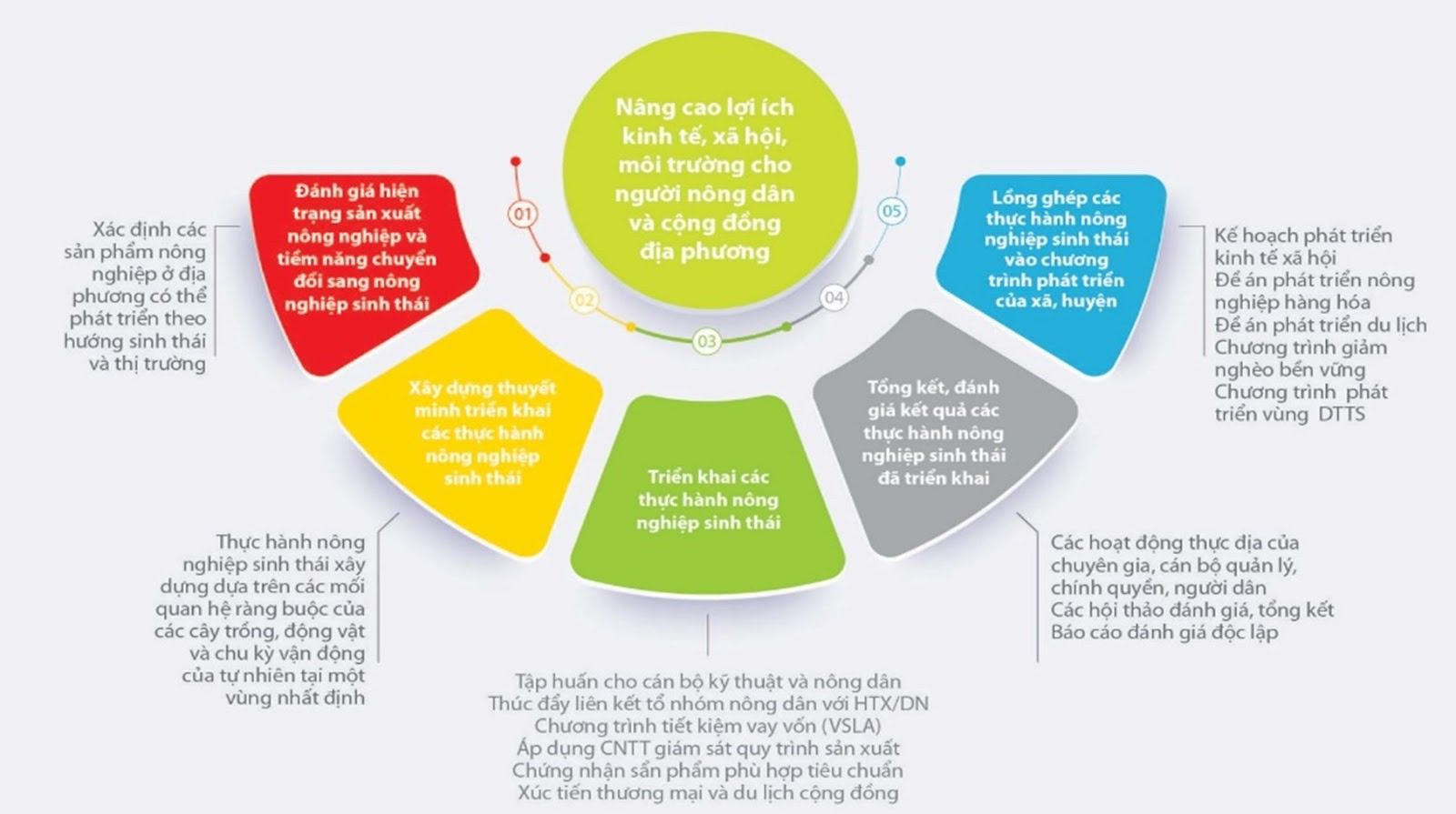
The project’s approach aims to promote agroecological practices following the process in the diagram below:
[Note: The diagram showing the agroecological practices process is not provided, so the description relies on the text.]
The approach to promote community tourism is divided into 3 stages: i) Survey and Planning: (Developing Community Tourism (CT) development plans for each village; designing detailed experiential tours; promoting the establishment of CT Management Boards and community tourism service groups in the villages). ii) CT Development Support Activities in the Village: (Training courses to enhance tourism service capacity; technical and financial support for families and communities to upgrade facilities and purchase equipment for tourism; guiding households in building investment plans for bank loans; developing CT development guidelines for the villages). iii) Communication and Market Linkage Activities: (Experiential tour programs connecting customers and the market; designing promotional communication videos and posters).
The project’s VSLA activity is implemented in coordination with local Women’s Union levels according to the following steps: i) Selecting Women’s Union officials for training to become core facilitators. ii) Core facilitators, together with the project, establish and maintain VSLA groups in the villages. iii) Promoting the application of IT in VSLA group activities.
With the implementation of Phase 2, it is expected to contribute to increasing the income and quality of life for ethnic minority households in the project areas through the application of agroecological solutions, community tourism, and Village Savings and Loan Associations.